Breakdown point in pictures
The breakdown point of an estimator is the largest fraction of the data you can replace with arbitrary outliers before the estimate becomes useless. It’s a theoretical guarantee, but it has a very concrete operational meaning: sweep contamination from zero to something high, fit your method at each level, and watch where the estimate stops tracking the true value.
Theoretical breakdown points:
Method |
Breakdown |
Why |
|---|---|---|
OLS |
0% |
A single huge outlier can move the fit arbitrarily far. |
Huber-M |
0% in |
Bounded loss helps on small-amount Y-only contamination, but no protection against high-leverage points. |
Theil-Sen |
~29% |
Median-of-slopes; breaks once contamination reaches the median. |
MM (bisquare default) |
50% |
The S-init step’s design is half the data; you’d need to corrupt more than half before MM falls. |
We’ll measure these by sweeping the contamination fraction.
import numpy as np
import matplotlib.pyplot as plt
import pandas as pd

from pylmrob import lmrob, Control
import statsmodels.api as sm
from statsmodels.robust.robust_linear_model import RLM
from sklearn.linear_model import TheilSenRegressor

rng = np.random.default_rng(0)
plt.rcParams.update({"figure.dpi": 110, "axes.grid": True, "grid.alpha": 0.3})

METHODS = ["OLS", "MM (pylmrob)", "Huber-M", "Theil-Sen"]
COLORS = {
    "OLS": "#d62728",
    "MM (pylmrob)": "#1f77b4",
    "Huber-M": "#ff7f0e",
    "Theil-Sen": "#2ca02c",
}
Setup
For each contamination fraction eps in {0.00, 0.05, 0.10, ..., 0.50}, generate a clean dataset of n=200 then replace
floor(eps * n) of the y values with large outliers
(y = 50 + N(0, 1)). Fit each method, record the slope. Repeat 25
times per eps and report the median + IQR.
def fit_slope(x, y, method):
    X = sm.add_constant(x)
    if method == "OLS":
        return sm.OLS(y, X).fit().params[1]
    if method == "MM (pylmrob)":
        df = pd.DataFrame({"x": x, "y": y})
        return lmrob("y ~ x", df, control=Control(), seed=42).coef_[1]
    if method == "Huber-M":
        return RLM(y, X, M=sm.robust.norms.HuberT()).fit().params[1]
    if method == "Theil-Sen":
        return TheilSenRegressor(random_state=0).fit(
            x.reshape(-1, 1), y).coef_[0]
    raise ValueError(method)


def contaminate_y(rng, x, true_intercept, true_slope, eps):
    """Generate (x, y) with fraction ``eps`` of y values replaced by outliers."""
    n = len(x)
    y = true_intercept + true_slope * x + 0.5 * rng.standard_normal(n)
    n_bad = int(np.floor(eps * n))
    if n_bad > 0:
        idx = rng.choice(n, size=n_bad, replace=False)
        y[idx] = 50.0 + rng.standard_normal(n_bad)
    return y


def sweep(eps_grid, n_rep=25, n=200, true_intercept=2.0, true_slope=1.5):
    """Return slope estimates as a (len(eps_grid), n_rep, len(METHODS)) array."""
    sim_rng = np.random.default_rng(42)
    x = np.linspace(0, 10, n)
    out = np.empty((len(eps_grid), n_rep, len(METHODS)))
    for i, eps in enumerate(eps_grid):
        for r in range(n_rep):
            y = contaminate_y(sim_rng, x, true_intercept, true_slope, eps)
            for j, m in enumerate(METHODS):
                out[i, r, j] = fit_slope(x, y, m)
    return out


eps_grid = np.linspace(0.0, 0.5, 11)
slopes = sweep(eps_grid)
slopes.shape  # (11, 25, 4)
(11, 25, 4)
Result
median = np.median(slopes, axis=1)            # (11, 4)
q25 = np.quantile(slopes, 0.25, axis=1)       # (11, 4)
q75 = np.quantile(slopes, 0.75, axis=1)       # (11, 4)

fig, ax = plt.subplots(figsize=(8, 5))
for j, m in enumerate(METHODS):
    ax.plot(eps_grid, median[:, j], lw=2, color=COLORS[m], label=m)
    ax.fill_between(eps_grid, q25[:, j], q75[:, j],
                    color=COLORS[m], alpha=0.18)

ax.axhline(1.5, color="gray", ls="--", lw=1, label="true slope")
ax.set_xlabel("contamination fraction ε")
ax.set_ylabel("estimated slope (median ± IQR across 25 reps)")
ax.set_title("Slope estimate vs contamination level")
ax.legend(fontsize=9, loc="lower left")
fig.tight_layout()
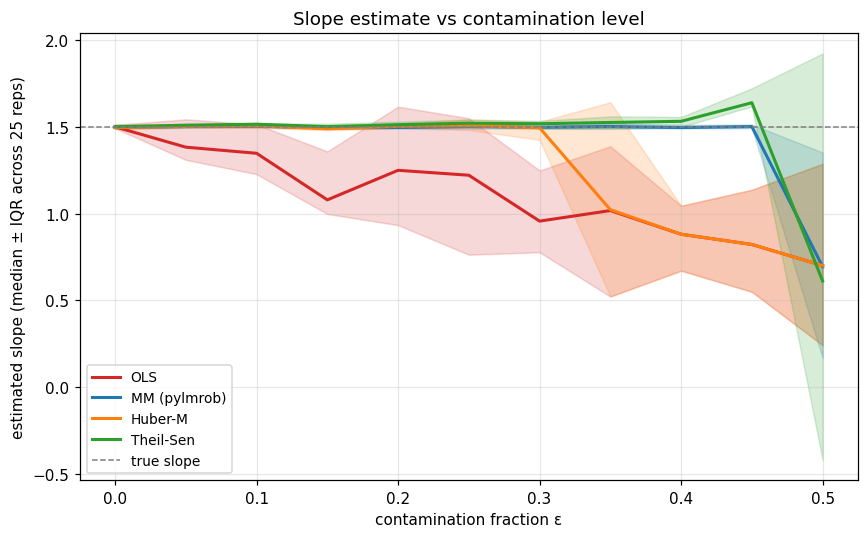
Reading the picture.
OLS drops the slope linearly. Even at ε=0.05 it’s already off. It has no notion of “outlier”.
Huber-M holds the slope close to 1.5 for a while — Huber’s bounded loss can absorb a few bad Y values — then drops as the contamination grows past ~25%. Its breakdown point is technically zero (a single bad point at high leverage can ruin it), but in this Y-only contamination scenario the operative bound is a fraction.
Theil-Sen holds until ε ≈ 0.29 (its theoretical breakdown), then collapses sharply.
MM stays close to the truth across the entire range. At ε very close to 0.5 it starts to wobble — the S-step’s half-the-data resampling has trouble finding clean half-subsamples — but it remains by far the best of the four.
The “cliff” at the breakdown point isn’t a soft boundary. Once the contamination passes the limit, the estimator’s design assumptions fail and the output is meaningless.
What ε=0.5 means in practice
A 50% breakdown point sounds like a lot of headroom. In real datasets it’s quite ordinary to have 1-5% contamination from data entry errors, sensor glitches, or fat-fingered inputs. The reason to use MM at 50% rather than M at, say, 20% is the distribution in leverage of those errors:
Y-only contamination (a sensor returns
999for a missing read, or a typo): Huber-M survives up to maybe 25%.Contamination that also moves
x(the same sensor returns(999, 999)): Huber-M’s breakdown drops to essentially zero. MM still survives because its S-init protects against leverage.
MM’s 50% breakdown is the worst-case safety net, not a typical operating point.
Next
04_s_estimator: why the S step is what makes MM achieve 50% breakdown — and what goes wrong if you skip it.